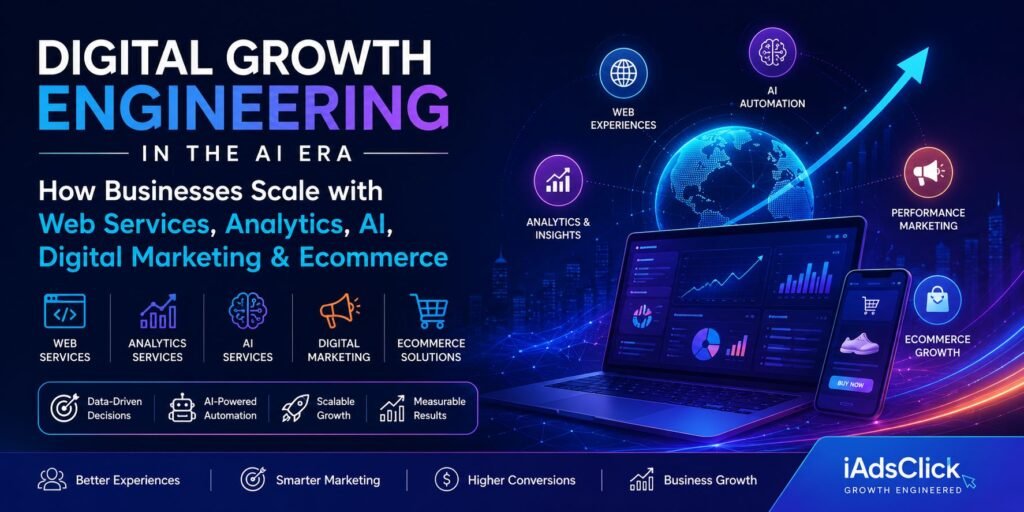
Digital Growth Engineering in the AI Era: How Businesses Scale with Web Services, Analytics, AI, Digital Marketing, and Ecommerce
What Drives Sustainable Digital Growth in 2026?
Sustainable digital growth comes from integrating web development, analytics, artificial intelligence, digital marketing, and ecommerce operations into a unified business growth framework.
Organizations that connect customer acquisition, analytics, automation, and conversion optimization outperform businesses that manage these functions separately. Modern growth requires data-driven decision-making, AI-enhanced operations, and scalable digital infrastructure.
Why Modern Businesses Need More Than a Website
A website is no longer just an online brochure.
A modern website must function as:
- Lead generation platform
- Customer acquisition engine
- Analytics collection system
- Ecommerce storefront
- AI-powered customer experience hub
- Marketing automation platform
Professional web infrastructure provides the foundation for digital growth.
Businesses seeking scalable online operations often start with professional web development services from:
Web Services
Web Design & Development Services
Key capabilities include:
- Corporate website development
- Ecommerce website design
- Conversion-focused landing pages
- Mobile-first user experiences
- Technical SEO architecture
- Performance optimization
- Lead generation systems
What Are Analytics Services?
Analytics services transform business data into actionable insights that improve marketing performance, customer acquisition, and revenue growth.
Without accurate analytics, organizations often make decisions based on assumptions rather than measurable outcomes.
Core Analytics Capabilities
| Analytics Function | Business Benefit |
|---|---|
| Customer Journey Analysis | Better Conversion Rates |
| Marketing Attribution | Improved Budget Allocation |
| Ecommerce Analytics | Revenue Optimization |
| Behavioral Analytics | Better User Experience |
| Predictive Analytics | Future Growth Forecasting |
| Performance Dashboards | Faster Decision Making |
Businesses implementing advanced analytics frameworks can identify growth opportunities that remain invisible through standard reporting tools.
Explore broader growth and analytics solutions through:
Growth Engineering & Analytics
How AI Is Transforming Business Operations
AI services automate repetitive tasks, improve operational efficiency, accelerate decision-making, and create scalable business systems.
AI adoption is no longer limited to large enterprises. Businesses of all sizes are deploying AI agents for customer support, internal operations, sales assistance, analytics, and workflow automation.
What Are AI Agents?
AI agents are autonomous software systems capable of performing tasks, making decisions, accessing information, and executing workflows with minimal human intervention.
Examples include:
- Customer support agents
- Lead qualification agents
- Sales assistants
- Ecommerce recommendation engines
- Analytics reporting agents
- Marketing automation agents
AI Deployment Services
Organizations seeking production-ready AI implementations can leverage:
Common deployment scenarios include:
- CRM automation
- Customer support automation
- Internal knowledge assistants
- Marketing workflow automation
- Data analysis systems
- Ecommerce support agents
Why Digital Marketing Requires Analytics and AI
Digital marketing performance improves significantly when campaigns are connected to analytics systems and AI-driven optimization frameworks.
Traditional campaign management often focuses on traffic generation.
Modern growth systems focus on:
- Revenue attribution
- Customer lifetime value
- Predictive audience targeting
- Automated bid optimization
- Conversion intelligence
- AI-powered campaign management
Digital Marketing Components
- Search Engine Optimization (SEO)
- Pay-Per-Click Advertising (PPC)
- Content Marketing
- Marketing Automation
- Conversion Rate Optimization
- Email Marketing
- Analytics Engineering
The strongest marketing programs combine data science, analytics engineering, and AI-driven decision-making.
Why Ecommerce Growth Requires an Engineering Approach
Ecommerce growth is no longer driven solely by advertising budgets. Successful ecommerce businesses optimize data, customer experience, operations, automation, and conversion systems simultaneously.
Modern ecommerce growth frameworks include:
Customer Acquisition
- SEO
- Paid Media
- Social Advertising
- Content Marketing
Conversion Optimization
- User Experience Improvements
- Landing Page Testing
- Checkout Optimization
- Product Discovery Enhancements
Analytics Infrastructure
- Customer Journey Tracking
- Revenue Attribution
- Cohort Analysis
- Behavioral Analytics
AI Integration
- Product Recommendations
- Customer Service Automation
- Dynamic Pricing Models
- Predictive Inventory Insights
How Businesses Scale Internationally
Organizations expanding into international markets require localized growth strategies, market-specific optimization, and regional digital infrastructure.
Example: Nordic Market Expansion
Businesses exploring growth opportunities in Northern Europe can benefit from localized digital strategies.
Sweden Digital Market Services
Localized market expertise supports:
- Market entry planning
- Regional SEO
- International PPC campaigns
- Ecommerce localization
- Analytics implementation
- Customer acquisition optimization
The Growth Engineering Framework
Growth Engineering combines analytics, AI, marketing, web development, and business intelligence into a single scalable system.
Unlike traditional marketing approaches, Growth Engineering focuses on measurable business outcomes.
Growth Engineering Components
| Component | Purpose |
|---|---|
| Web Infrastructure | Customer Acquisition Foundation |
| Analytics Engineering | Measurement & Attribution |
| AI Systems | Automation & Intelligence |
| Digital Marketing | Traffic Generation |
| Ecommerce Optimization | Revenue Growth |
| Business Intelligence | Strategic Decision Making |
Organizations that integrate these disciplines create stronger competitive advantages than those operating in isolated silos.
Emerging Long-Tail Search Trends
Businesses increasingly search for:
- AI-powered business growth solutions
- Enterprise analytics implementation services
- Ecommerce revenue optimization frameworks
- Customer journey analytics consulting
- Marketing attribution engineering services
- AI workflow automation for enterprises
- Conversion tracking implementation services
- Business intelligence and analytics consulting
- Digital transformation growth frameworks
- Scalable marketing operations solutions
These long-tail searches reflect growing demand for integrated growth systems rather than standalone marketing services.
Frequently Asked Questions
What are analytics services?
Analytics services help businesses collect, analyze, visualize, and interpret data to improve decision-making and growth performance.
How do AI agents help businesses?
AI agents automate workflows, support customers, improve operational efficiency, and assist with data-driven decision-making.
Why is ecommerce optimization important?
Ecommerce optimization improves customer experience, conversion rates, revenue generation, and long-term profitability.
How do analytics improve digital marketing?
Analytics reveal which channels, campaigns, audiences, and customer journeys generate the highest business value.
What is Growth Engineering?
Growth Engineering combines web development, analytics, AI, digital marketing, and business intelligence to create scalable business growth systems.
Conclusion
The businesses achieving sustainable growth are integrating web services, analytics, AI, digital marketing, and ecommerce into unified operating systems rather than managing them as separate functions.
As competition increases and AI-driven discovery platforms reshape customer behavior, organizations need stronger digital foundations, advanced analytics capabilities, intelligent automation, and conversion-focused growth strategies.
Explore how Growth Engineering can transform business performance through: